

LFAST: A scalable array telescope for photon starved science in the visible and near-infrared.
The Large Fiber Array Spectroscopic Telescope (LFAST) Project is lead out of the University of Arizona's Steward Observatory and is sponsored by Schmidt Sciences as one component of the Eric and Wendy Schmidt Observatory System.
LFAST is trying to solve two fundamental problems that are limiting the construction of new large ground-based optical and near-infrared observatories: 1) the cost of a telescope grows exponentially with its collecting area, and so building telescopes bigger than the currently under construction GMT, ELT, and TMT is out of reach of astronomy budgets; and 2) the time required to build a new telescope is currently measured in decades, not months or years.
LFAST is tackling these problems by designing and building arrays of telescopes for seeing limited astronomy. These telescopes can be replicated in large quantity to form arrays with huge collecting area, rivaling or exceeding the light collecting capability of the giant telescopes currently being built, but at a much lower cost. This idea was first proposed 50 years ago by Roger Angel and colleagues at Steward Observatory. Observatories built with this design will be well suited to photon starved science of faint objects and also time domain studies of transient phenomena. Some examples include the rapid followup of energetic transients like supernovae, studying the atmospheres of of extrasolar planets, exploration of faint extragalactic targets, and fundamental stellar and star formation astrophysics.
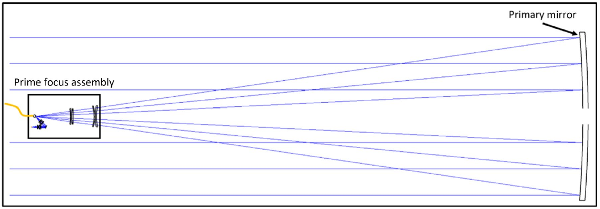
The LFAST design is built around a 76 cm diameter, f/3.3 prime focus "unit" telescope. The unit telescope uses spherical primary mirrors, fabricated out of inexpensive 1-inch thick Borofloat glass. The top end of each telescope includes a four element refractive corrector that removes spherical aberration over an 8-arcmin field of view, atmospheric dispersion correction, and high-speed vibration correction to remove windshake. Light from the telescopes is fed into optical fiber at prime focus, which can deliver it to scientific instruments. The unit telescope optical design is optimized to deliver light from 400 nm to 1700 nm. More details of the optical design are described in Berkson et al. 2024.
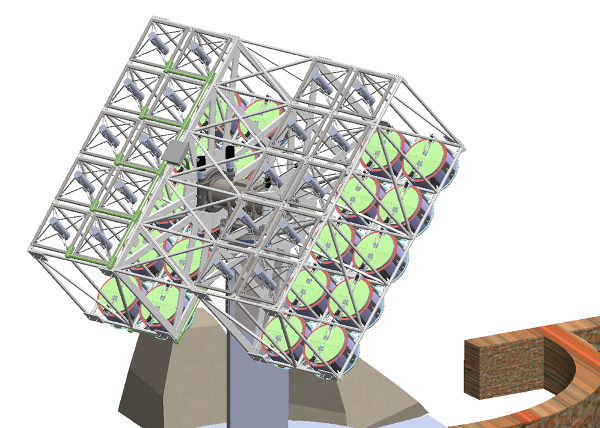 Twenty unit telescopes are held in a frame and manipulated by a single altitude-azimuth drive system, which can point the telescopes to any location on the sky and provide tracking at sidereal and non-sidereal rates. This structure sits on a narrow concrete pier, with the drive systems close to the center-of-mass of the system. Each mirror is surrounded by a robust mirror cover to protect against inclement weather and cover the mirrors during daylight hours, so no large dome is required. This reduces both the site impact and the overall development costs, since traditional domes are very expensive. The collecting area of a 20-unit system is equivalent to a traditional 3.5m single mirror telescope. Ten systems provide the collecting area of a 10-m class telescope. One-hundred systems are equivalent to a giant telescope.
LFAST is currently building our first prototype facility, which we plan to deploy to an observatory site near Tucson later this year. We plan to provide a medium resolution spectroscopy for visible wavelengths from ~400 - 900 nm and high-resolution near-IR spectroscopy from ~1.08 - 1.7 microns.
The LFAST Team:
The LFAST project is made possible by a large team of faculty, engineers, technicians, and students:
| Leadership Team: | Hardware Engineering and Technical Team: | Students and Postdocs |
| Chad Bender (Co-Principal Investigator) | Joel Berkson (Optical Scientist) | Zsombor Antel (Optical Design) |
| Roger Angel (Co-Principal Investigator) | Gilberto Chavez Lopez (Electrical Engineer) | Naman Bajaj (Fiber Fabrication) |
| Andrew Monson (Co-I, Telescope Scientist) | Nick Didato (Thermal Engineer) | Nina Brown (Spectrograph Lead) |
| Richard Wortley (Project Manager) | Trevor Dugan (Mechanical Technician) | Sonja Choi (Fiber Lead) |
| Dennis Zaritsky (Project Scientist) | Samuel Halverson (Co-I) | Megan Delamer (Micro-Optics Fabrication) |
| Peter Gray (Senior Engineer) | Daewook Kim (Co-I) | Glen Douglass (Optical Coating) |
| Warren Foster (Optics Lead) | Riley Mikkelsen (Software Engineer) | Yiyang Huang (Wavefront Control) |
| Kevin Gilliam (Controls and Electronics Lead) | Chang Jin Oh (Co-I) | Chris Kruep (Systems Engineering) |
| Jason Patrou (Integration Lead) | Brian Scaramella (Software Engineer) | Keita Maekawa (Optical Coating) |
| Fernando Parra (Project Coordinator) | Melanie Sisco (Optical Technician) | Milan Riha (Mechanical Design) |
| Christian Schwab (Co-I, Optical Scientist) | Naomi Yescas (Electrical Engineer) | Peter Shea (Control Systems) |
| William Thompson (Mechanical Lead) | David Zeller (Mechanical Engineer) |
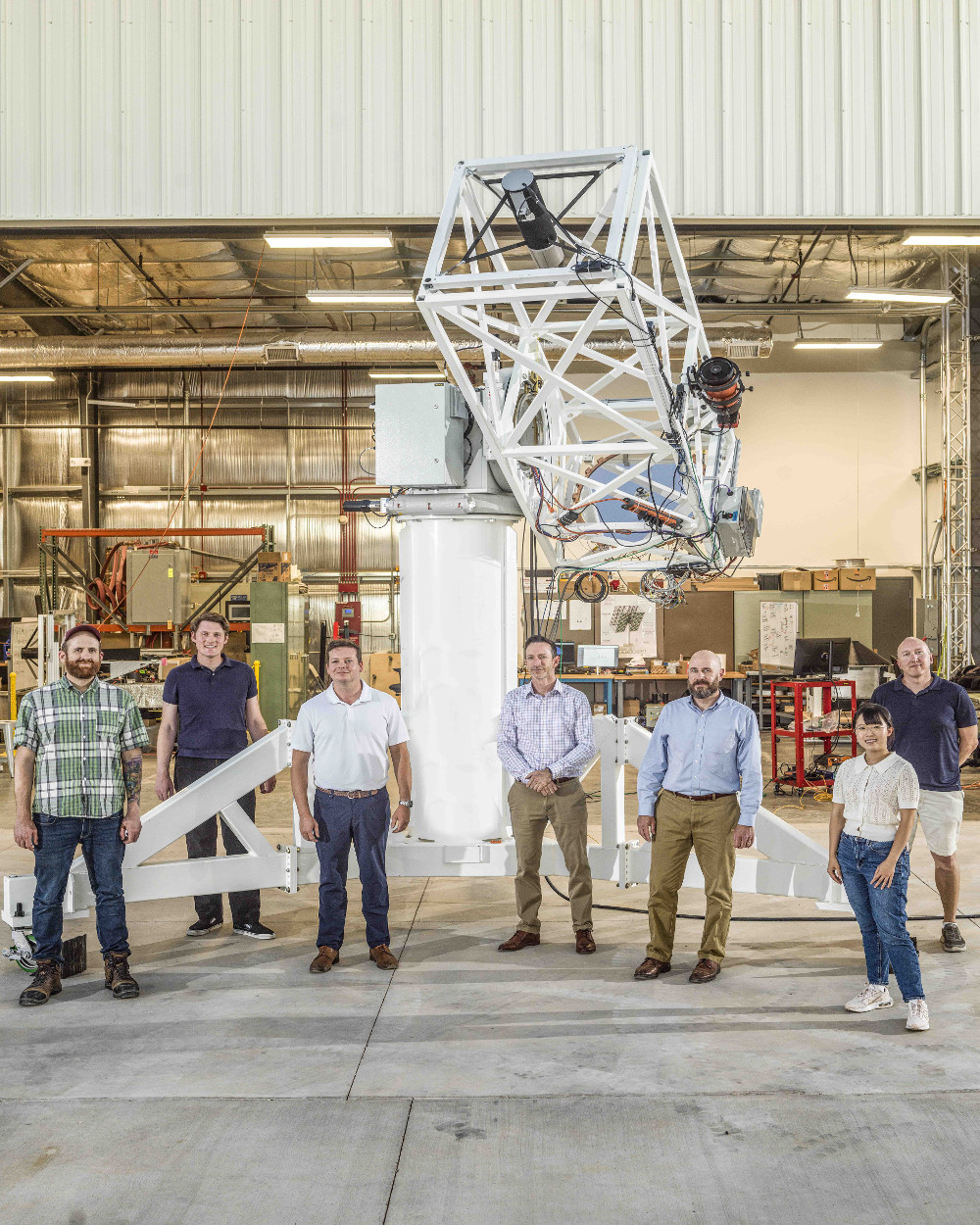
For more information about LFAST, please reach out to Chad Bender or Roger Angel