

Turbocharging SPHEREx: How U of A Cosmologists Are Using AI to Unlock the Universe's Largest Galaxy Survey

The Spectro-Photometer for the History of the Universe, Epoch of Reionization and Ices Explorer (SPHEREx) mission will provide an all-sky spectral survey.
NASA Jet Propulsion Laboratory
Starting May 1st 2025, NASA’s SPHEREx mission has been in low-earth orbit conducting the first ever all-sky infrared spectral survey. Over the course of 2 years, SPHEREx will eventually map the position and redshifts of ~450 million galaxies. Cosmologists ultimately aim to use the distribution of those galaxies to investigate the first fraction of a second after the big bang – a period known as cosmic inflation – through tiny differences in the overall distribution of matter today.
In order to place tight constraints on our model of inflation, scientists first need analysis pipelines that are both accurate and computationally feasible to use, which is a non-trivial challenge given the complexity of the modelling involved. In a new study posted to arXiv, U of A astronomers have built a new neural network model that speeds up these slow modelling calculations by a factor of 900.
This new model, called an emulator by experts, utilizes modern machine learning architectures to generate realistic theoretical predictions of what’s known as the galaxy power spectrum. The power spectrum broadly describes the distribution of galaxies we observe, and depends on both the underlying cosmology, and nuisance parameters that arise from systematics in the modelling and data acquisition. This new emulator learns the relationship between each of these inputs to the final observable we expect to see from SPHEREx such that you can predict the power spectrum much faster than running a more traditional analytic model.
“That amount of speedup really enables us to do much more robust studies on how all our different analysis choices impact our conclusions from the data,” says Joe Adamo, graduate student working in Steward Observatory’s Arizona Cosmology Lab and principal author of the new study. “We’re deeply involved in the SPHEREx mission here in the AZCosmoLab, and we and our collaborators are really excited to start using this model to do just that.”

Joe Adamo
Joe and his colleagues set out to test this new model by running mock SPHEREx analyses with it, and comparing the result to what you get from using a more standard power spectrum modelling code. They found that the emulator achieves excellent agreement at the parameter contour level, with minimal bias and negligible change in error bars, which serves as solid evidence that the model is production-ready for running SPHEREx analyses.

This study, as well as others being done by the group, involve significant contributions from undergraduate students. In this case, many aspects of the emulator structure and training settings needed to be optimized to get the best performance for the given problem. This work was primarily done by Grace Gibbins, a current senior in the Physics department at U of A.
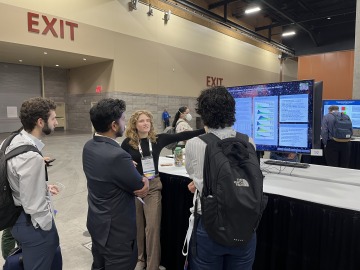
Grace Gibbins presents her work
“Grace’s work was instrumental in completing this project”, says Joe, “and in general we love to give undergrads the opportunity to do impactful research in our group. In fact, we’ve started working with another undergrad on a different SPHEREx-related project.” Indeed, with SPHEREx now in orbit and the emulator ready to go, the team's next step is clear: use it to rigorously stress-test their analysis pipeline by exploring analysis choices like which scales to include in the data, so that when the time comes to analyze the real thing, they'll be ready.