

Former CEO of Google spearheads 4 next-gen telescopes — 3 on Earth and 1 in space
"We're going to do it in three years, and we're going to do it for a ridiculously low price."

Four new telescopes could usher in a new era of astronomy.
Schmidt Sciences/Chris Gunn
PHOENIX, Arizona — On Wednesday (Jan. 7), scientists made a major announcement at the 247th meeting of the American Astronomical Society: Four next-gen telescopes have secured private funding, and they should roll out at a very rapid pace. Three are ground-based scope arrays and one is a space observatory named Lazuli that would have 70% more collecting area than the Hubble Space Telescope. If all goes to plan, Lazuli could launch as soon as 2029.
"We're going to do it in three years, and we're going to do it for a ridiculously low price," Pete Klupar, executive director of the Lazuli project, said during the conference.
The announcement comes from Schmidt Sciences, a philanthropic organization forged by Wendy Schmidt and Eric Schmidt, the latter of whom was CEO of Google from 2001 to 2011. It's notable for a philanthropic organization to be the driving force behind so many big astronomy projects — with specific costs yet to be revealed — for a couple of reasons. For one, the Trump administration has become notorious over the last year for undermining science in different ways, like slashing science organization budgets (including NASA's, though Congress is fighting those cuts) and laying scientists off in hefty swaths at a time.
"Between the congestion of space and the tightening of government budgets, a storm of possibilities is formed," Klupar said. "If we stick to traditional timelines, we lose generations of data. On the other hand, we can't be slapdash. We must move forward, but we must not compromise on our mission success."
If everything works out, Lazuli will become the first privately funded space telescope in history. This is a big deal because, while we've seen commercial interests clearly permeate the space sector over the last several years, they haven't so much aligned with what some may call "science for science's sake" these days — at least not as strongly as the Schmidt Observatory System appears to.
Jeff Bezos' aerospace company Blue Origin, for instance, has been taking paying customers to the edge of space since 2021, and Elon Musk's SpaceX still has its eye on landing humans on Mars. The first private lunar lander made a touchdown on the moon just last year, and even climate-focused companies have sent private satellites to space in order to monitor our planet's health. But a powerful space telescope being funded without government assistance still seems like a shift.
"One of the reasons why we're better is because we have one shareholder. This eliminates analysis paralysis," Klupar said. "We've proven this model works in commercial spaceflight. It's been proven in the small [satellite] revolution. Now we're investigating how to apply those lessons to large-aperture astronomy."
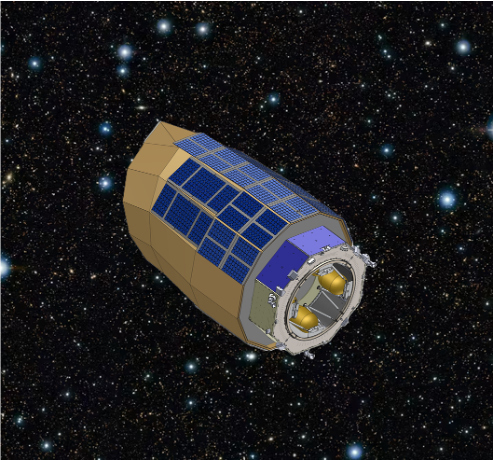
An illustration of the Lazuli space telescope. (Image credit: Schmidt Sciences, LLC)
To get into some specifics with Lazuli: The telescope will have a 3.1-meter-wide (10.2 feet) mirror, meaning it should capture 70% more light than the iconic Hubble Space Telescope. It is expected to provide quick observations across both near-infrared and optical wavelength bands, and will be placed into a lunar-resonant orbit, a known cost-effective and stable orbit option.
The telescope will have three instruments: a wide-field optical imager, an integral field spectrograph and a high-contrast coronagraph. Scientists are especially excited about the coronagraph, because this instrument can be used to directly image exoplanets.
"There's a lot of technology that we're going to demonstrate on Lazuli that will complement what [NASA's upcoming Nancy Grace Roman Space Telescope] is doing and help us find the path most quickly and efficiently to get to Earth-like planets around sun-like stars," Ewan Douglas of the University of Arizona said during the conference.